

Every year, thousands of seniors slip in the bathroom but choosing the right shower seat can dramatically reduce that risk.
If you’re trying to make a parent’s bathroom safer, the shower is usually the first place to start — and for good reason. Wet floors, tight spaces, and the simple act of stepping over a tub ledge can quickly become a fall risk.
If you’re working on a full bathroom safety setup for seniors aging in place, see our Bathroom Safety guide.
Free Safety Resource
I created a simple 2-page Bathroom Safety Checklist to help seniors and caregivers spot common fall risks and make easy safety improvements.
👇 Download the free checklist here:
One of the easiest upgrades is adding a shower seat. But many families get stuck on the same question:
Should you buy a shower chair… or a shower transfer bench?
In this guide, I’ll explain the difference, who each option is best for, what to avoid, and what features matter most, in a simple, caregiver-friendly way.
According to the CDC, more than one out of four adults age 65 and older falls each year —resulting in roughly 3 million emergency department visits annually. Falls are a leading cause of injury for older adults, which is why making the bathroom safer is such an important first step in aging-in-place.
This article contains affiliate links. If you make a purchase through these links, we may earn a small commission at no extra cost to you. This is not medical advice. Always follow manufacturer instructions and consult a professional if needed.
Quick Answer (Best Choice Fast)
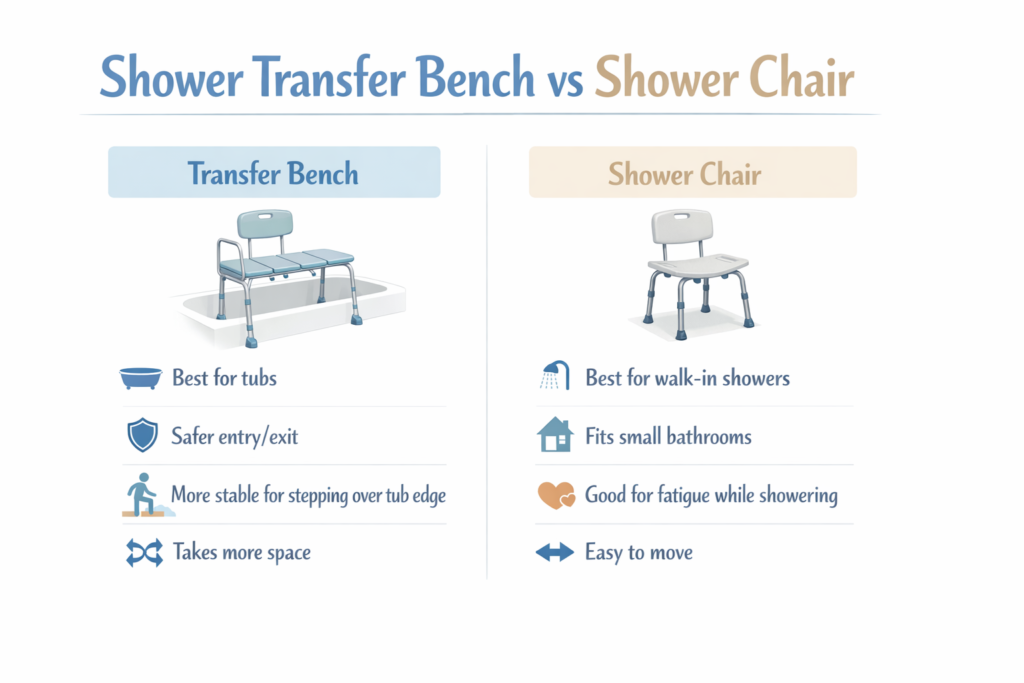
Choose a shower transfer bench if your loved one:
- struggles stepping into the tub or shower
- needs help lifting legs over the tub edge
- feels unsteady during the “getting in / getting out” part
- uses a walker or wheelchair
- has weakness after surgery, illness, or rehab
If stepping over the tub edge feels risky, a shower transfer bench is often the safest place to start.
Choose a shower chair if your loved one:
- can step into the shower safely but needs to sit while washing
- has fatigue, arthritis, or balance concerns
- has a walk-in shower (no big step to get over)
- needs a smaller footprint for a tight shower
For walk-in showers and smaller spaces, a shower chair with a backrest can be a simple, comfortable upgrade.
If space is tight, here are my favorite options for the best shower chairs for small bathrooms.
Signs a Transfer Bench May Be the Safer Choice
A shower transfer bench is often the better option if your loved one:
- feels nervous stepping over the tub edge
- has to “hold onto the wall” to get in or out
- struggles lifting one leg at a time
- has had a recent slip, near-fall, or fall in the bathroom
- uses a walker, cane, or wheelchair
- gets shaky or tired standing long enough to shower
- needs help from a caregiver during bathing
If any of these sound familiar, a transfer bench can reduce the most dangerous part of showering: getting in and out safely.
If a transfer bench is the safer option for your situation, we’ve reviewed the best shower transfer benches for seniors to help you compare stable, easy-to-use models.
Top Picks (Quick Recommendations)
If you want the safest choice without overthinking it, here are the options most families start with:
- Best for tubs (safer entry/exit): A shower transfer bench with a backrest
- Best for small showers: A compact shower chair with arms + back
- Best for extra stability: A heavy-duty transfer bench (higher weight capacity)
👉 You can browse these options here: Transfer Benches on Amazon and Shower Chairs on Amazon
What’s the Difference Between a Shower Chair and a Transfer Bench?
Shower Chair (sits fully inside the shower)
A shower chair is a seat that stays completely inside the shower or tub. It’s best for seniors who can get in safely, but benefit from sitting during bathing.
Common features:
- adjustable legs
- non-slip feet
- backrest (sometimes)
- armrests (sometimes)
Shower Transfer Bench (half in / half out)
A transfer bench is longer than a shower chair. It sits with:
- two legs inside the tub/shower
- two legs outside the tub/shower
This allows your loved one to sit down outside the tub first, then shift into the shower area more safely.
Some transfer benches also include a sliding seat, which can make moving across easier.
Safety Comparison
Transfer Bench vs Shower Chair
1) The highest-risk moment is getting in and out
Most slips don’t happen while someone is calmly sitting and washing.
They happen when someone is:
- stepping over a tub wall
- turning around in a small space
- balancing on one leg
- reaching for support that isn’t stable
A transfer bench reduces this risk because your loved one can sit down first, then move slowly.
✅ Winner for entry/exit safety: Transfer bench
2) Stability and tipping risk
Both can be safe if they’re sturdy and set up correctly.
In general:
- a transfer bench has a wider base and longer frame
- a shower chair is smaller and may shift more easily if it’s too light
A transfer bench can still feel unsafe if:
- the legs aren’t level
- the tub floor is slippery
- it’s not assembled tightly
✅ Winner for overall stability: Transfer bench (usually)
3) Support for weak legs and balance issues
If your loved one has:
- poor balance
- leg weakness
- fear of falling
- trouble lifting feet over the tub edge
…a transfer bench is often the safer choice.
✅ Winner for balance issues: Transfer bench
4) Best option after surgery or rehab
After surgery or a hospital stay, many seniors struggle with:
- lifting legs
- pivoting safely
- standing long enough to bathe
A transfer bench reduces standing and stepping.
✅ Winner for recovery needs: Transfer bench
Comfort + Ease of Use (What Seniors Actually Prefer)
Seat size and weight capacity
Look for:
- a wide, sturdy seat
- a weight capacity that matches the user (with extra room)
Quick Tip: If your loved one is close to the max weight limit, choose a heavy-duty model for better stability and confidence.
Backrest and armrests
These features can make a big difference for:
- feeling secure while seated
- pushing up to stand more safely
In general:
- shower chair with arms + back = great for confidence
- transfer bench with backrest = helpful if sitting longer
Height adjustability
A good fit looks like:
- feet flat on the floor
- knees comfortable
- no wobbling
Bathroom Fit Check (Before You Buy Anything)
This is the step that prevents most frustration and returns.
Tub vs walk-in shower
- Transfer benches are best for tubs or showers with a threshold
- Shower chairs are best for walk-in showers or smaller stalls
Small bathroom limitations
Transfer benches take up more room. Make sure:
- the bathroom door can still open
- there’s space for a caregiver to stand nearby
- it won’t block the toilet or vanity
Shower door vs shower curtain
Transfer benches usually work best with shower curtains.
If your shower has sliding glass doors, you may need to:
- remove the doors
- or choose a shower chair instead
Simple measuring guide (fast + easy)
Measure:
- tub width (outer edge to inner wall)
- tub height (step-over height)
- inside tub floor space
- shower opening width
Before buying, many families also add a non-slip bath mat outside the shower to reduce slipping during step-out. A good mat is one of the easiest upgrades.
Which One Is Better for Different Mobility Levels?
Independent seniors (mild balance concerns)
Often best with:
- shower chair with back
- non-slip mat
- grab bar
Seniors who need caregiver help
Transfer benches can be easier because the caregiver can assist from outside the tub.
If you’re helping a parent bathe, choose the option that reduces lifting and twisting. A transfer bench often makes transfers smoother — and protects the caregiver’s back too.
Walker or cane users
Transfer benches are often safer because the user can:
- walk to the bench
- sit down outside the tub
- move in slowly
Wheelchair users
Many wheelchair users do best with:
- a transfer bench
- or a sliding transfer bench
- depending on strength and bathroom layout.
What to Avoid (Common Mistakes That Make Shower Seats Unsafe)
Mistake 1
Choosing the wrong size
Too small = unstable
Too large = doesn’t fit well and blocks movement
Mistake 2
Skipping slip protection
Even the best chair can shift if the surface is slick. Use:
- non-slip bath mat outside the shower
- non-slip tub strips/stickers (if appropriate)
Mistake 3
Ignoring weight limits
Weight capacity isn’t only about “will it hold.” It affects:
- stability
- wobble
- confidence when sitting down
Mistake 4
Treating suction grab bars like permanent support
Suction grab bars can be helpful for light support in some situations, but they’re not a replacement for properly installed grab bars when real weight-bearing support is needed.
| Feature | Transfer Bench | Shower Chair |
|---|---|---|
| Best for tubs | ✅ Yes | Sometimes |
| Best for walk-in showers | Sometimes | ✅ Yes |
| Safer entry/exit | ✅ Best | Moderate |
| Takes up more space | ✅ Yes | No |
| Easier for caregivers | ✅ Often | Depends |
| Better for weak legs | ✅ Yes | Yes |
| Easier setup | Moderate | ✅ Easier |
Top Picks (General Recommendations)
Before we get to the top picks, here’s how I chose them: I focused on options that are stable, easy to adjust, simple to clean, and supportive for everyday use, especially for seniors who feel unsteady in the shower. I also prioritized designs that work well in real homes (including smaller bathrooms), not just “perfect” setups.
👉 Want to browse options first? Click here to see shower transfer benches on Amazon.
⭐ Top Pick #1: Best Overall Transfer Bench (Most Seniors)
Look for:
- adjustable legs
- backrest
- non-slip feet
- sturdy frame (no wobble)
- drainage holes
Here are a few transfer benches with backrests that meet these safety basics.
👇Check out the Medline Transfer Bench for Bathtubs and Showers here:
⭐ Top Pick #2: Best Shower Chair for Small Bathrooms
Look for:
- compact footprint
- backrest
- armrests if possible
- adjustable legs
- stable, non-slip feet
If you’re working with a smaller shower, these compact shower chairs are usually easier to fit.
👇 Check out the Vive Folding Shower Chair here:
⭐ Top Pick #3: Best Heavy-Duty Option (Extra Stability)
Look for:
- higher weight capacity
- reinforced frame
- wider seat
- extra-grip feet
For higher fall risk seniors, a heavy-duty shower seat can feel more secure.
👇 Check out the PELEGON Heavy Duty Shower Chair (450lb) here:
Budget / Mid-Range / Premium (What You Get)
Budget (basic safety upgrade)
Usually includes:
- simple seat
- basic adjustability
- Best for: light support needs
Mid-Range (best value for most families)
Usually includes:
- sturdier build
- backrest and/or arms
- Best for: seniors who feel nervous about slipping
Premium (maximum comfort + easiest transfers)
May include:
- sliding seat
- padded options
- heavy-duty construction
Best for: higher fall risk or caregiver-assisted bathing
| If your loved one… | Best choice |
|---|---|
| Can step in but gets tired standing | Shower chair |
| Has trouble stepping over the tub edge | Transfer bench |
| Has balance issues when turning | Transfer bench |
| Has a small walk-in shower stall | Shower chair |
| Needs caregiver help | Transfer bench |
| Uses walker or wheelchair | Transfer bench (or sliding bench) |
Must-Have Add-Ons for Safer Showering (Highly Recommended)
These small upgrades make either option safer:
- Non-slip bath mat (outside the tub/shower)
- Grab bars (stable support)
- Handheld shower head (easier rinsing while seated)
- Shower caddy placed within easy reach (less bending/twisting)
- Soft, absorbent bath rug (reduces water tracking)
A handheld shower head is one of the best upgrades for seated showering, especially for seniors with limited reach.
Before you go — don’t miss this!
Free Bathroom Safety Checklist (PDF)
If you’re making updates to improve bathroom safety, this checklist can help you catch small issues that are easy to overlook.
It’s a quick, printable guide for seniors and caregivers.
👇Get the free Bathroom Safety Checklist here:
FAQs (People Also Ask)
Is a shower transfer bench safer than a shower chair?
Often yes, especially for tubs, because it reduces stepping over the ledge.
Who should use a transfer bench instead of a shower chair?
Anyone with trouble stepping in, poor balance, leg weakness, or a higher fall risk.
Can a transfer bench be used in a walk-in shower?
Sometimes, but many walk-in showers don’t have enough space. A shower chair may fit better.
What’s better for seniors with balance problems?
A transfer bench is often safer because it reduces standing and turning.
Are sliding transfer benches worth it?
They can help higher fall risk seniors or wheelchair transfers, but they cost more.
How do I know what size shower chair to buy?
Measure your shower floor space and choose a chair that fits without crowding.
What is the safest way for an elderly person to get into the shower?
Stable support, non-slip surfaces, and sitting down early (transfer bench if needed).
Final Recommendation + Next Steps
If you’re still unsure, here’s the simplest rule:
✅ If stepping over the tub edge feels risky, choose a transfer bench.
✅ If stepping in is okay but standing feels tiring, choose a shower chair.
Either way, pairing your seat with a non-slip mat and proper grab bar support can dramatically improve safety and confidence.
Next Steps:
- Measure your tub/shower space
- Choose the right seat type
- Add at least one slip-prevention upgrade
- Test the setup slowly and calmly (no rushing)