

Toilet Safety Frame vs Toilet Safety Rails: Which Is Better for Bathroom Safety?
When adding bathroom support for seniors, two common options often come up: toilet safety frames and toilet safety rails. While both are designed to help with sitting and standing, they work in different ways and choosing the wrong one can lead to discomfort or poor fit.
In this guide, we’ll compare toilet safety frames vs toilet safety rails to help you decide which option is better for your bathroom layout, space constraints, and support needs.
This comparison is part of our broader Bathroom Safety guides focused on making everyday home bathrooms safer for seniors.
This article contains affiliate links. If you make a purchase through these links, we may earn a small commission at no extra cost to you.
What Is a Toilet Safety Frame?
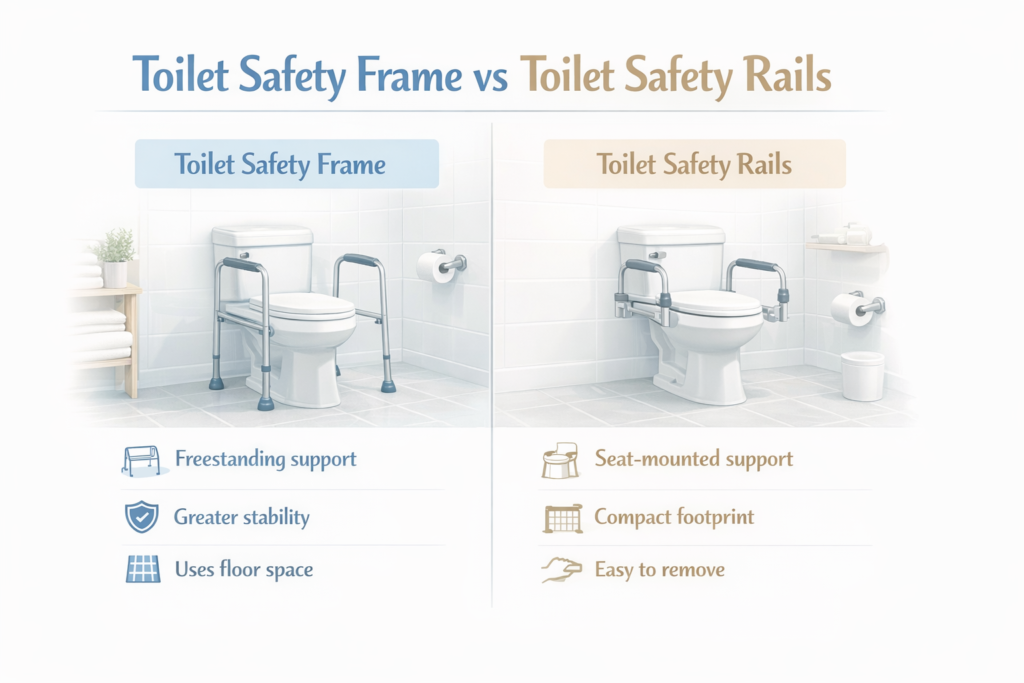
A toilet safety frame is a freestanding support structure that sits around the toilet. It typically has two handles and four legs that rest on the floor, providing stable support for sitting down and standing up.
Because toilet safety frames are not attached to the toilet seat itself, they can feel more solid for users who need stronger balance support. Many frames are adjustable in height and width, making them suitable for a variety of bathroom layouts.
- Freestanding design with legs on the floor
- Handles on both sides for balanced support
- Adjustable height and width on most models
- No drilling or permanent installation required
- Often feels sturdier for users with limited strength
What Are Toilet Safety Rails?
Toilet safety rails are seat-mounted supports that attach directly to the toilet bowl under the seat. The handles extend outward on one or both sides to provide leverage when sitting or standing.
Because toilet safety rails attach to the toilet itself, they usually take up less floor space than a full frame. This makes them a popular choice for smaller bathrooms or situations where a freestanding frame would feel bulky.
- Mounted directly to the toilet under the seat
- Minimal footprint on the bathroom floor
- Adjustable handle height and width on many models
- Quick installation without tools
- Lighter and easier to remove than full frames
Key Differences Between Toilet Safety Frames and Rails
Toilet safety frames and toilet safety rails serve similar purposes, but they differ in design, footprint, and overall support. Understanding these key differences can make it easier to choose the option that fits your bathroom and mobility needs.
| Feature | Toilet Safety Frame | Toilet Safety Rails |
|---|---|---|
| Installation | Freestanding | Attaches to toilet seat |
| Floor Space | Requires some floor space | Very minimal |
| Stability | Often feels more solid | Depends on toilet stability |
| Ease of Removal | Moderate | Very easy |
| Best For | Stronger support needs | Limited space or lighter support |
Which Is Better for Small Bathrooms?
In small bathrooms, toilet safety rails are often the easier fit because they don’t add legs or frames to the floor. They attach directly to the toilet, keeping walkways clearer and reducing the chance of bumping into nearby fixtures.
However, compact or foldable toilet safety frames can still work well in smaller bathrooms if space allows. These frames offer more stability than rails, which may be important for users who feel unsteady.
For space-limited setups, choosing between rails and a compact frame often comes down to how much support is needed versus how much clearance is available.
If you’re specifically dealing with limited space, our guide to best toilet safety frames for small bathrooms covers compact options designed for tighter layouts.
Frame vs Rails: Which Provides More Stability?
For users who need maximum stability, a toilet safety frame is usually the better choice. Because the frame rests on the floor, it doesn’t rely entirely on the toilet for support, which can feel more secure during standing.
Toilet safety rails still provide helpful assistance, but they depend on the toilet being firmly installed. For lighter support needs or balance assistance, rails can be sufficient and more convenient. If this sounds like it fits your needs, you may want to explore our recommendations for toilet safety rails for seniors.
Installation Ease: Frame vs Rails
Both toilet safety frames and rails are designed for easy home installation without tools. Toilet safety rails are usually faster to install because they simply attach under the toilet seat and can be removed just as easily.
Toilet safety frames may require a bit more adjustment to set the correct height and width, but they still do not involve drilling or permanent changes. This makes both options suitable for renters or shared bathrooms.
When a Toilet Safety Frame Makes More Sense
- The user needs stronger, more stable support
- Balance or leg strength is significantly limited
- The bathroom has enough floor space
- A freestanding option feels more secure
When Toilet Safety Rails Are the Better Choice
- The bathroom is very small or narrow
- Minimal floor obstruction is important
- The user needs lighter assistance
- Quick removal or portability is needed
Final Recommendation
Both toilet safety frames and toilet safety rails can improve bathroom safety when chosen correctly. Frames tend to offer stronger support, while rails are easier to fit in tight spaces and simpler to install.
If you’re unsure which option is best, consider how much stability is needed and how much room is available around the toilet. For product recommendations and space-specific guidance, you may also want to explore our guides to best toilet safety rails for seniors and best toilet safety frames for small bathrooms.
Frequently Asked Questions (FAQ)
Are toilet safety frames safer than rails?
Both can be safe when installed properly. Frames often feel sturdier, while rails work well when the toilet is securely mounted and space is limited.
Do toilet safety rails damage the toilet?
No. Most rails install under the toilet seat without permanent changes and can be removed without damage.
Can seniors use both options at different times?
Yes. Some households switch between rails and frames as mobility needs change over time.
Before you go — don’t miss this!
Free Bathroom Safety Checklist (PDF)
If you’re making updates to improve bathroom safety, this checklist can help you catch small issues that are easy to overlook.
It’s a quick, printable guide for seniors and caregivers.
👇Get the free Bathroom Safety Checklist here: